Politics
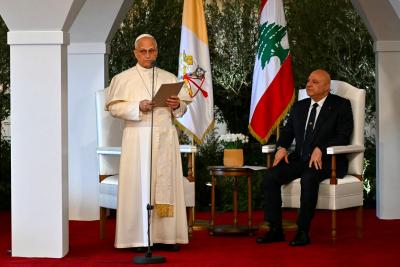





For the second time since entering the Lebanese file, U.S. envoy of Lebanese origin Tom Barrack has suggested that Lebanon and Syria should be a single state.
He repeated the statement twice. Yes—twice.
Was it a slip of the tongue? Did he voice what he knows? Or did he simply articulate what he wishes for, independently of his administration—perhaps influenced by his official assignment to the Syrian portfolio, in addition to his primary post as U.S. ambassador to Turkey?
Barrack, who is of Lebanese origin, regained Lebanese citizenship during the tenure of former president Michel Sleiman. He regained it as though it were merely ink on paper, seemingly unaware of Lebanon’s history. Had the laws applied by civilized nations to those seeking their nationality been enforced, he would have been required to pass an official examination in the history of the country whose citizenship he sought.
On that basis—and since our “brother in Lebanese citizenship” appears to be inventing a version of history to his own taste—I will give him four lessons in Lebanese history and examine him on them, so that, should he pass, he may truly deserve the honor of holding Lebanese nationality.
Lesson One
My fellow citizen, Tom, here is the first lesson.
Lebanon was known in antiquity for its city-kingdoms: Tyre, Sidon, Byblos, Tripoli, Baalbek—cities that imposed themselves on the ancient world and produced a civilization that offered humanity five gifts no other civilization did: El, the god of love; the alphabet; noسo-democracy (governance based on the power of two councils); the intuition of the atom; and the Euclidean geometry.
Some may ask why these cities did not form a single empire or kingdom, like the empires and kingdoms that once dominated the East.
The answer is simple: geographical obstacles prevented their unification into a single kingdom, even though their people were one, as were their language and religion. Among these obstacles were Ras al-Shaq‘a (the area of today’s Chekka tunnel), the hill of the Nahr al-Kalb (today’s Nahr al-Kalb tunnel), and the Awali River.
For further clarification, according to Greek and later Roman divisions, these city-kingdoms (except Baalbek) were known as Coastal Phoenicia, extending north to Ugarit and south to Acre, while the non-desert Syrian interior was called Lebanese Phoenicia.
Lesson Two
And now, fellow citizen Tom, lesson two. From Lebanon, three elements are for me one : life, reason, and divinity.
Life:
The amber mountains celebrated in a Rahbani poem were not merely a poetic image. Poetry often precedes science and truth. Amber science—by permission of Professor Danny Azar—states that the oldest amber containing a flowering plant was found in Lebanon, dating back 135 million years. Flowering plants are the hallmark of life.
Thus, Lebanon is the giver of life on Earth.
Reason:
The Phoenician alphabet was devised after cuneiform, pictorial, and hieroglyphic “alphabets,” to organize reason and thus accelerate time itself. Since then—more than three thousand years ago—human reason and time have been indebted to Cadmus of Lebanon.
Divinity:
God sent His only Son as a human. Qana of Lebanon returned Him to God as divine, when the Virgin Mary hastened the moment of the proclamation of His divinity, bringing about the miracle of wine, the first sign of Jesus Christ on Earth.
Greater Lebanon, which celebrated its centenary five years ago, remains what Gabriel Hanotaux once described as “the highest peak in history.” I would add: the highest peak in human generosity.
Lesson Three
O Lebanese-American Tom, here is the third lesson.
The oldest written text known to history is the Sumerian Epic of Gilgamesh, composed in the mid–third millennium BCE and discovered on twelve baked clay tablets, with a Babylonian version dating back to the second millennium BCE.
The name Lebanon appears twice in the Epic of Gilgamesh. This means that the name of our homeland is at least 4,500 years old—aside from its dozens of later mentions, especially in the Holy Bible, the Old Testament, where it appears 309 times explicitly (Lebanon 72 times) and implicitly (the mountain, the cedar, Sidon, Tyre, Byblos).
Accordingly, the name Lebanon is the oldest among the names of states, and wherever it appears, it is associated with four attributes only: immortality, sanctity, greatness, and beauty.
Lesson Four
Dear brother in Lebanese citizenship, Tom, here is the fourth and final lesson—The former French ambassador to Lebanon, Bruno Foucher, wished the Lebanese a happy New Year some years ago without forgetting to remind us that his country had “created Lebanon a hundred years ago.”
I then told His Excellency —and repeat it to you today—that one day, during a meeting at the French embassy in 1992 with a group of activists, at a time when Syria had extended its control over Lebanon under American cover, a French ambassador—whose name escapes me—repeated the same claim: “We created Lebanon a hundred years ago.”
I asked him: Do you have a copy of the Bible?
He said yes.
I said: Let us read together.
In the Book of Joshua (13:6):
“…and all the land of the Gebalites, and all Lebanon, toward the sunrise, from Baal Gad below Mount Hermon to the entrance of Hamath…”
And in the Book of Judges (3:3):
“…all the Canaanites, the Sidonians, and the Hiouites who lived in Mount Lebanon, from Mount Baal Hermon to the entrance of Hamath…”
He asked me: And what do you mean by that?
I replied: The borders of Lebanon are clearly defined in the Bible—from Akkar to Marjayoun.
And I added: God is the one who drew the borders of Lebanon—no one else.
Dear Tom, my brother in citizenship, please stop wishing to annex us to others and keep such wishes for yourself.
It is enough for us to be self-sufficient—even if some of our rulers and people are pleased with their subservience to Uncle Sam.
Peace.
Note: The exam score is set at 1701…
Please post your comments on:
[email protected]